
125 years of Norwood Oval
The Norwood Football Club is today recognising and celebrating 125 years since the first game at Norwood Oval.
In 1850 William Clarke established a house, vineyard and garden on the site bounded by The Parade, Osmond Terrace, Beulah Road, & Sydenham Road. In 1896 the land was bought by Mr Thomas Verco who offered to sell seven acres to the Kensington & Norwood Corporation for use as a recreation ground by the residents of Norwood. Ratepayers rejected this offer twice and a private company, the East Torrens Recreation Ground Company Limited was formed to lease and develop the land.
The Norwood Oval became a shared recreational ground primarily for the Norwood Football Club and the East Torrens Cricket Club.

These gentlemen were the prime instigators and developers of the oval: (L-R): Sir E.T. Smith K.C.M.G., A.W. Piper, J.Darling Jnr. M.P., Jas. Hall J.P., J.H. Mattingly J.P., W.O. Whitridge and Dr. A.E. Shepherd in front.
1901 Norwood Oval opens
Vines were removed, the oval was formed and fenced and change rooms constructed.
Norwood Oval was the club’s fourth home ground, after the East Parklands (1878 to 1881 now the CBC Oval on Bartels Road) Kensington Oval (1882 to 1897) and the Jubilee Oval (1898 to 1900) The first football match on the oval was played on Saturday, 4th May between Norwood and the new affiliated SAFA club Sturt with Norwood winning 10.11 to Sturt 5.8
In 1902, a permanent grandstand was built in the north-western pocket (now part of the RSL Clubrooms).
1905 Lease transferred to Council
The East Torrens Recreation Ground Company Limited transferred its lease of the oval to the Norwood & Kensington Corporation with the provision that the Council maintained the area as a recreation ground for the general public.

1906 Official opening
The official opening of the oval and grandstand by the Council was on March 14th and attended by the Governor, Sir Alexander Hore-Ruthven, Local government dignitaries, prominent citizens and the districts school children.
1909 The Parade entrance
The original entrance to the oval was from Osmond Terrace through the Norwood Primary School, but when the new electric tramline from the city came along the Parade, a new Parade entrance was formed and opened on May 1st.
1910 Deeds of freehold
Thanks to the donation of 2,000 by Sir Edwin T. Smith on his 80th birthday, the Council was presented with the freehold title to Norwood Oval. He was a generous patron of the Norwood Football Club from its foundations in 1878. Sir Edwin T. Smith (“the grand old man of Norwood”) died on Christmas Day, 1919 aged 88.
1929 Sir Edwin T. Smith Pavilion
After nearly 10 years of discussions and a possible move to Kensington Oval, the southern-end grandstand was built and named the Sir Edwin T. Smith Pavilion.
It was opened by the Governor, Sir Alexander Hore-Ruthven on May 18th . Mr. S. Talbot Smith, son of Sir E.T. Smith, unveiled the plaque. It was one of the largest and best appointed pavilions in Australia at that time.
The Council transferred the original Osmond Terrace entrance to the Education Department in return for a strip of land along the eastern boundary to enable the oval to be widened by 30 feet (10 metres).
Other improvements were made with mound accommodation, terracing and an electric time bell installed.

1936 Returned Services League Hall
The original grandstand built in 1902 in the north-west corner was converted into a hall and taken over by the Returned Services League (RSL) and later in 1942 and 1953 substantial additions were made to the building.
1941 Record individual score
Champion full forward Bruce Schultz kicked 19 goals 2 behinds against Glenelg in round 12, on July 19th.
The highest individual score by any player on the Norwood Oval was made even more remarkable by the fact that he hit the goal post twice. Norwood won the game 29.7 to 17.13.
He became the first Norwood player to kick 100 goals in a season. He kicked his 100th goal in Round 13 of the 1941 season, injured his knee in that game and never played again.
Bruce Schultz is the highest goalscorer for Norwood with 669 goals kicked in 124 games for the club, and has kicked the most goals on Norwood Oval, 335 goals in 54 games at an average of 6.20 goals per game.
The great Ken Farmer played his last game on Norwood Oval and retired with 1419 goals at an average of 6.3 goals per game.
1943
In February, about 5,000 people saw USA’s ‘Alabama Kid’ defeat Australia’s Ernie Horne in a light heavyweight boxing bout on the Norwood Oval.
The fight ended in the second round after four minutes of boxing, when the towel was thrown into the ring from the Horne camp. The fight was most disappointing for the spectators, who did not forget to show their annoyance at the fiasco!
1951 Lights at the Oval
Norwood Oval was the first suburban oval to erect light towers and led to the oval becoming a pioneer
venue for night football and other sports, especially baseball in the 1950’s, 60’s & 70’s.

1952 Hopalong Cassidy
The popular American cowboy Hopalong Cassidy (William Boyd) and his white horse, Topper, entertained thousands of fans on the oval in 1952 and was a very successful fund-raiser for the Crippled Children’s Association.
1953 Centenary Pavilion
Due to the increase use of the oval following the erection of floodlights, the Centenary Pavilion was built to accommodate more spectators.
It was named to celebrate the centenary of the Kensington & Norwood Council which is the oldest local government council in Australia.

1954 Night football
A night football competition, The Advertiser Cup, was played at Norwood Oval. Norwood won the cup in 1956 and 1958 and the series continued to 1961.Night football on the national stage is the basis for the AFL and it all began at Norwood Oval.
Glenelg rover, Stan Wickham rode a bicycle onto Norwood Oval in a gesture to Journalists who wrote that he would need a bike to keep up with the Norwood rovers. He was charged by the SANFL with misconduct and suspended for one game!
The Redex Reliability Trial attacted huge crowds leading to traffic jams in the streets of Norwood. Competitors’ cars were parked on the playing surface of Norwood Oval.
1955 Players’ race
The players’ race was installed from the Sir Edwin T Smith Pavilion to the oval. These races were installed at all suburban grounds as a consequence of clashes between players and spectators at the 1954 grand final between Port Adelaide and West Adelaide.
A new scoreboard was erected by Hallweld Limited at the northern end of the oval and was later extended to display other SANFL scores and also horse racing results.
1959
In February, a professional exhibition tennis match was held between Lew Hoad and Ken Rosewall, with Hoad winning 5-7, 7-5, 6-4.
1962 The Essery Stand
The Centenary stand was extended northwards and was named after William Essery Jnr., a local builder, former Mayor, club committeeman from 1913 – 1938 and a much-admired club patron from 1949 – 1973.
1963 Renovations
The Norwood Football Club took great strides in its history when major renovations were made to its change rooms and social clubrooms. The redevelopment was considered by SANFL officials to be the best of its kind in the State. Alterations were also made to the League, Seconds, Thirds and committee rooms, and a new room for the Colt’s team and an Umpires’ room were made available in the Centenary stand.
Norwood could boast in having a social room and change facilities equal to anything in Australia. These developments were all due to the hard work of Club President, Mr Bert Baulderstone & his committees.
1966 International Rugby
On 11 May 1966 the touring British Lions rugby team defeated a South Australian team 38 -11
1964
Popular Sydney singers Col Joye, Judy Stone and Sandy Scott were among the artists at a concert on Norwood Oval compered by radio station 5AD disc jockey Bob Francis.
1968 The Redlegs Club
The Redlegs Club was officially opened in Woods Street on March 12 with all social & administrative activities transferred from the oval premises.
The huge area under the Sir Edwin Smith Pavilion was completely fitted out as a gymnasium for the benefit of the players.
A world double wicket cricket competition was held on Norwood Oval on 14th October 1968, with Australia defeating the West Indies.
1969 Players race and Mini-league
The Norwood & Kensington Corporation constructed an underground players’ race from the Sir E T Smith grandstand corridor to the playing arena. Both competing teams shared the race to enter and leave the arena.
The Coca Cola sponsored Mini-League competition commenced on April 5th with the first match at Norwood Oval on April 26th. The under 11 age school teams played two seven minute halves with modified rules across the oval using portable goalposts.
1971
The oval was the controversial venue for the South African Rugby Union team’s match against South Australia when anti-apartheid demonstrators using smoke bombs invaded the pitch to try and stop the game.
Norwood and Port Adelaide attracted a record post-war match crowd of 20,280 on May 22.
1972 Removal of cricket pitch
The cricket wicket square was removed which significantly improved the oval as a football venue and the East Torrens Cricket Club moved to Campbelltown Oval. The club had played their matches on the Norwood oval for 71 years.
1973 SANFL Finals at Norwood Oval
When the final five finals system was used for the first time, two matches were played on the Norwood oval. Norwood were involved in both games, defeating Port Adelaide in the Elimination final on Sept. 8th , but were defeated by North Adelaide by five points the following week in the first semi-final.
The SANFL headquarters, Football Park at West Lakes became the principal oval for league football in 1974.
1974 Norwood Oval facelift
The oval received a major upgrade with grandstands, fences, corridors and changerooms repaired and painted.
The three impressive flagpoles on the Edwin T. Smith pavilion, a feature since 1929, were removed for safety reasons. To assist captains to determine the strength and direction of the wind, a windsock was erected on the south-eastern mound.
1976 National Football League night series
The first national night series was conducted mid-season on the Norwood Oval involving five teams from Victoria, three from Western Australia and four from Adelaide. The generously sponsored series was an innovation with matches telecast and a large spectator following was drawn to the oval.
The night championships were very successful. Norwood was a semi-finalist and ranked third in the series. A memorable 106 point victory over Carlton in the first round was one of Norwood’s most famous victories.
The grand final between Hawthorn and North Melbourne was the only grand final ever played by VFL teams outside of Melbourne. Hawthorn won the championship.
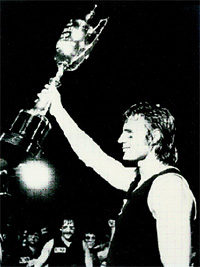
1977 The Ardath Cup
Norwood won the National Football League championship,the Ardath Cup, defeating East Perth in the grand final by eight points.
A new record high score of 33.21 (219) was scored against North Adelaide 10.9 (69)
1979 Re-surfacing of the oval
The constant usage of the oval since the re-introduction of night football in 1976 and heavy rain resulted in the surface being unplayable. The ground managers, The City of Kensington and Norwood Council, undertook a comprehensive programme to completely re-surface and re-seed the oval in November 1979.
1987 Lease of the Norwood Oval
On January 2nd, 1987, the Norwood Football Club became ground managers of the Norwood Oval.
The lease was for 10 years with a right of renewal for a further 10 years. The City of Kensington and Norwood had controlled the oval since 1905. A separate lease between the council and the SANFL stipulated that Norwood must play at least seven home matches each season. The council received a percentage of the gate for league home matches and any trial games. The club was responsible for the cost of power for running the floodlights.
Glass fronted enclosures were constructed to accommodate the coaches and support staff of both teams.
1988 Spectator facilities improved
With the co-operation and funding from the Council, bench type seating to accommodate 400 patrons was installed in a designated alcohol free area on the eastern wing.
A pre-match brawl erupted between Norwood and Central District players behind the southern goals when both teams congregated at the Parade end for their warm-up. As a consequence the SANFL introduced new rules stipulating that teams must use opposite ends of the ground to conduct their warm-ups, with the home team to use the end nearest their change rooms.
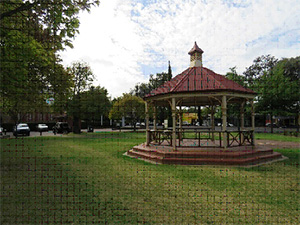
1991 Soldiers Memorial Gardens upgraded
The beautification of The Parade frontage was completed in 1991, with the Sound Shell replaced with an attractive Rotunda. The fountain was de-commissioned and converted into a circular rose garden and the car park fences were removed. The attractive open space complemented the new Parade park design of the Soldiers Memorial Gardens.
A lighting upgrade was completed to enable the SANFL to programme night fixtures at Norwood during the home and away season.
The Oval Committee’s objective was to make the Norwood Oval the centre for night sport. However, with the advent of the Adelaide Crows into the AFL, home game attendances fell by 38% and the committee was ever alert for the need to attract additional income to maintain the oval’s financial viability.
The 1991/92 baseball season marked 40 years of senior baseball including Claxton Shield interstate matches, played at Norwood.
1991 League locker room upgraded
Each of the 35 lockers in the league room was repainted to feature the names of all players with their guernsey numbers who had completed a minimum of 100 league games with Norwood since 1878. An asterisk indicated each players involvement in a premiership team.
1993 Corporate boxes in the Sir Edwin T. Smith pavilion
Six corporate boxes were constructed in the southern grandstand in an effort to attract more corporate support. With attendances diminishing since the Adelaide Crows entry into the AFL in 1991 the southern grandstand was rarely fully occupied on match days.
1994
The Norwood Football Club was granted a 50 year lease by the Kensington & Norwood Council.
1997 Night football for premiership points
The Norwood Oval was used for night matches in the home and away season. Norwood played Central district on April 11th to officially launch the upgraded lighting facilities.
1999 National Baseball League fails
The Adelaide Giants tenure at the Norwood Oval finished with demise of the National Baseball League ending a long association with the Norwood Oval since 1951.
2001 Centenary year
Norwood Football Club celebrated 100 years of football on the Norwood Oval with a re-enactment of the first match played against Sturt in 1901. The game was played for premiership points on May 4th before a crowd of 13,745 spectators. It was a spectacular occasion with players dressed in period costumes for the pre-match warm-up. Norwood won 12.10 (86) to Sturt 9.13 (67)
The club published a booklet, detailing the history of Norwood Oval. A plaque was unveiled on May 4, 2001 to commemorate 100 years of football on the Norwood Oval. It also recognised the Sturt Football Club’s centenary.
The refreshment outlet on Coopers Hill was rebuilt by past player and tradesman, Gerry D’Antiochia, at a cost of $20,000 with sponsorship support from Coopers Brewery.
Coopers Hill has become a very popular viewing area for generations of spectators.
2003 The Redlegs Club sold
The Redlegs Club was sold to developers for $3.2 million and a proposal to build new headquarters at the rear of the southern grandstand was considered by the Board. Members ultimately rejected the plan and overturned the Board.
A newly elected Board acquired the Norwood Community Club at 138 The Parade. This property became the club’s social base until sold in 2006 for $5.4 million dollars.
2004 The Redlegs Club demolished
The Redlegs Club was demolished to make way for a new housing estate. The club’s limited social activities were transferred to the Premiers Bar and on match days to the RSL clubrooms.
Premier’s Bar – A major upgrade, costing $20,000 was undertaken in the area beneath the Baulderstone Stand. It was first known as ‘Macca’s Bar’ following the retirement of champion centreman and captain Garry McIntosh in 1999 and then later renamed the Premiers Bar. It was the club’s only licensed area open to members most afternoons with the club’s honour boards and photographs on display.
2005 Cooper’s Corner
A substantial new food and beverage outlet was erected in the north-western corner of the oval and fitted out by Coopers Brewery. In all $25,000 was expended on the project. Coopers corner is an outstanding spectator facility and a very popular viewing area on match days.
The player’s gymnasium and warm-up area was refurbished for the commencement of the season.
2006 Major improvements
The SANFL donated sections of their redundant bench type aluminum seating at Football Park to suburban grounds. Norwood’s allocation was installed in various sections around the oval perimeter.
President, Joe Tripodi generously donated new goal posts which were sourced from Football Park at a cost of $7,000.
Change rooms re-modelled –
President, Joe Tripodi, was the driving force behind the project . A major upgrade of the player’s change rooms was undertaken prior to the 2006 playing season. A steel mezzanine floor was constructed above the league player’s locker room extending to the western wall of the Sir Edwin T. Smith pavilion to create two new rooms for coaches and players. In the downstairs section a shower block, toilets and lockers were constructed. A players’ lecture room with video equipment was completed at the western end of the corridor. Access to the mezzanine was made from the corridor via a staircase.
It was the first major upgrade of player facilities since 1963 when newly appointed club President, Bert Baulderstone, substantially remodelled the change rooms.
Wally Miller Gates – With the sale of the Redlegs Club, the Wally Miller Gates, which were erected in 1995 and opened across the eastern end of Florence Street, were dismantled and placed in storage. The ornate wrought iron gates were slightly modified and positioned at the Woods St entrance near the RSL clubrooms.
2007 Coopers Stadium
In a generous sponsorship deal the Norwood Oval became known as Coopers Stadium.
2008 Visiting league team room upgrade
The visiting league change rooms at the eastern end of the Sir Edwin T. Smith pavilion received a substantial makeover in January 2008. Funds for the project were provided by the SANFL as a part of a plan to upgrade the visitors’ change rooms at all suburban ovals. Only the lockers and bench seating were retained from the original interior.
Norwood’s lowest score – On May the 23rd Norwood scored 1 goal 3 behinds against Glenelg. It was Norwood’s lowest score on the Norwood Oval since league football commenced at The Parade in 1901.
On the 12th of December the club’s administration was re-located at the western end of the mezzanine floor of the southern grandstand. A steel stairway constructed in the breezeway provides the external entrance to the administration offices.
2009
After an absence of 10 years, baseball returned to Norwood Oval with the formation of the Adelaide Bite team in the national competition
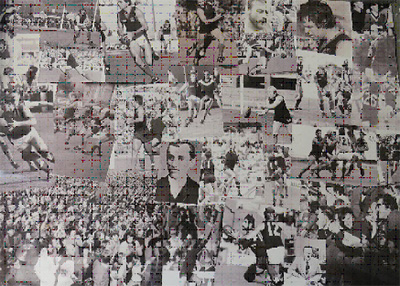
A collage of action football photographs initiated by groundsman, Barry Solomon, was installed in Coopers Corner in 2009.
A remote control digital timeclock was erected on the scoreboard.
2011
‘The Brian Prestwood Family Zone’ was created on the eastern wing in memory of Brian Prestwood, a resident of Minda Home, and a life-long passionate and devoted Norwood supporter. A memorial plaque is located on the eastern wing
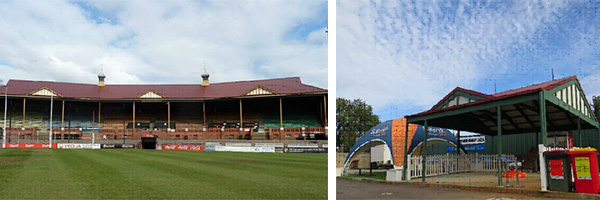
Club sponsor, Australian Outdoor Living, constructed a covered pergola at the northern end in conjunction with a new family area, provided by Dean and Margaret Southwood, wonderful long-time supporters and benefactors.
New ice baths were installed for the players, the gymnasium was re-carpeted and the trainer’s room re-modelled.
The Council replaced the roof on the Sir Edwin T. Smith Pavilion.
The Pavilion and Centenary Stand were painted and fascias replaced.
2015
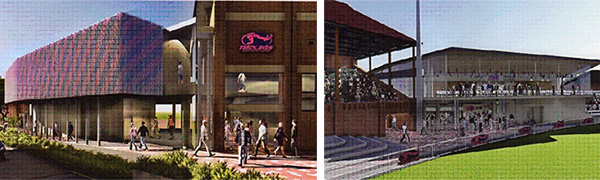
In collaboration with the Norwood, Kensington & St Peters Council, plans were developed for a new community-based clubroom between the Sir Edwin T. Smith Pavilion and Centenary Pavilion, with a completion date in 2019.
The Wally Miller gates abutting the RSL Hall were rebuilt.
2016
Fund-raising for the new clubrooms began with renown winemaker and club benefactor Wolf Blass donating $500,000 toward the project. Other fund-raising activities will continue throughout the next three years to assist in financing the project.
2017
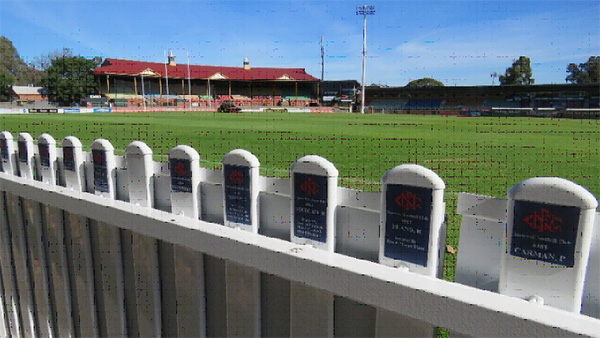
One significant project around the oval was the construction of a new white picket fence with plaques of Norwood past players attached.
The club named the northern end of the oval after champion half-forward flanker and Hall of Fame inductee, Roger Woodcock.
2018
At the club’s AGM it was announced that wine-maker Wolf Blass had donated a total of $1 million to assist the club to build a new multi-purpose community facility available to all residents, businesses, schools and organisations. It will be called the Wolf Blass Community Centre.
2019
Coopers Corner in the north-western pocket was upgraded.
Seating refurbishment for the Sir Edwin T Smith grandstand.
2020
Largest LED screen for a suburban oval installed next to the existing scoreboard.
The gymnasium under the Sir E.T. Smith Pavilion was completely renovated.
2021
The Wolf Blass Community Centre was officially opened on 22nd January.
Major refurbishment of the existing changerooms under the Sir E.T. Smith and the Centenary Pavilions.
2022
Installation around the picket fencing of a 300 metre LED strip for sponsor signage.
The 4 light towers around the oval were upgraded.
2023
The Premiers Bar adorned with graphic displays illustrating the club’s premierships.
Plans developed for the Redlegs Museum to be located under the Centenary Pavilion.
Installation of 42 iconic action photographs in the corridor under the Centenary Pavilion and is known as ‘The Long Gallery’.
In April the AFL’s inaugural Gather Round included two games at the oval. Fremantle defeated Gold Coast before a crowd of 9,329 and GWS defeated Hawthorn before a crowd of 9,057.
2024
AFL Gather Round returned in April with Brisbane defeating North Melbourne before a crowd of 9,037 and St Kilda defeated Richmond before a crowd of 9,425
2025
AFL Gather Round games were again held in April when Brisbane defeated Western Bulldogs drawing a crowd of 9,242 and GWS defeated St Kilda with a crowd of 9,235.
2026
The Aish Family Lawns on the northern mound at the Norwood Oval was opened by club number one ticket holder Andrew Pridham AO on 10 April 2026.
AFL Gather Round games in April featured Sydney defeating Gold Coast before a crowd of 9,228 and Geelong defeating West Coast before a Norwood Oval Gather Round record crowd of 9,434.
Related News
-
 Club News
State U18 Boys & Girls Team Selection – Game 1
-
 Club News
Senior Women’s Leadership Program, run by Pique Global
-
 Club News
Famous Norwood names added to the Western Stand
-
 Club News
League releases SANFL Men’s & SANFL Women’s fixtures
-
 Club News
Captain Kennerley brings up 100 games
-
 Club News
Sacrifice the key as Kennerley kicks on to 100 games
-
 Club News
Norwood FC’s 2026 First Nations Round Guernsey
-
 Club News
West End State Team named for 2026 KIA State Game


Platinum Partners